Pages

Friday, April 19, 2019

Health Care Reform Articles - April 19, 2019

I agree with Angus King on health care — sort of

by Philip Caper - Bangor Daily News -  April 17, 2019

I agree with Sen. Angus King’s frustration, expressed in his March 31 BDN OpEd, with the seemingly endless debate about how best to provide access to health care to all Americans. I have known King for more than 40 years, dating back to the time we were both on the staff of the U.S. Senate. In general, I agree with King’s politics, and admire his skills as a politician. But in the case of the debate about health care, I disagree with his analysis.
In his OpEd, King decries the Groundhog Day nature of our national health care debate, yet advocates putting yet another patch on the Affordable Care Act rather than replacing it with something better.
He writes, “The ACA isn’t perfect, but it’s made people’s lives better, and that’s worth building on by making simple fixes around the edges rather than tearing it apart or repealing it entirely.” His sentiment is a noble one. But, as Albert Einstein once put it, “The definition of insanity is doing the same thing over and over again and expecting different results.” There have been many attempts to patch up our insurance-and-market-based system. All have failed.
In Maine, Dirigo Healthcare is a prime example. It was launched in 2003 by then-Gov. John Baldacci but never achieved its coverage goals and was allowed to sunset in 2014 by Baldacci’s successor, Gov. Paul Le Page — with hardly a whimper from the public.
In Massachusetts, Romneycare achieved better coverage than did Dirigo, but it has failed to reign in out-of-control health care costs. As a result single-payer health care bills have once again been introduced in the Massachusetts Legislature.
Patching our fundamentally flawed insurance-based system will not solve our health care problems. The problem is not one of designing better insurance, because insurance itself is the problem.
Medical underwriting, the fundamental business of commercial insurance, is all about finding ways to discriminate against sick people or those who are likely to become sick, in order to increase shareholders’ profits. Do we really want a health care financing system that discriminates against sick people? We need to create a system better than insurance.
The ACA lacks adequate cost controls when we’re already spending too much and getting poor results for our money. Furthermore, patches to the ACA will do nothing to fix the extreme fragmentation of our current health care system. That would only contribute to the ongoing confusion and polarization about health care reform that have created our current political gridlock.
Improved Medicare for all would introduce sorely lacking budgets into every level of the system, going a long way toward controlling out-of-control health care costs. And a gradual transition to a new and better system can limit the disruption that is inevitable with any change of this magnitude.
King is a very smart and thoughtful politician with a sophisticated understanding of the complexities of American health care. But on this issue he’s a bit too cautious. He has yet to endorse improved Medicare for all, the one solution that would put an end to his Groundhog Day.
Winston Churchill once said, “Americans will always do the right thing, once they’ve exhausted all alternatives.” Now is the time.
Philip Caper of Brooklin is an internist and founding board member of Maine AllCare.

Bernie Sanders Has an Important Lesson for Republicans

by Peter Suderman - NYT - April 10, 2019

Last week, Bernie Sanders released the latest version of his “Medicare for all” plan, which would establish a federally run single-payer system to finance care for everyone in the United States. The plan has changed little from its previous iterations, but there is one crucial difference: This version is backed by several of Mr. Sanders’s rivals for the Democratic presidential nomination.
Republicans are, by most appearances, thrilled — or at least relieved — to be running against Mr. Sanders and his plan, which would wipe out most private health insurance coverage, with prominent Republican politicians from President Trump on down taking repeated swipes at the idea.
But rather than simply mocking him, Republicans should take a minute to learn from what he has accomplished, and how. You don’t have to support single payer — I certainly don’t — to see that Mr. Sanders has been remarkably successful as a policy entrepreneur.
Working as an outsider over the course of a long political career, he has moved a sweeping and radical idea into the mainstream of Democratic policymaking. In doing so, he has modeled a certain kind of tenacious political salesmanship, using the Senate and his presidential campaigns as platforms to advance a major policy idea without initial backing from party leadership.
Few if any legislators on the right are attempting anything comparable. And yet they could. The strategies Mr. Sanders employed would be available to any Republican or independent right-of-center politician inclined to use them.
First, and most important, he had a clear vision, and he has tirelessly made the case for that vision and the benefits he believes it will provide: coverage for everyone, no premiums or co-payments, no maze of insurance paperwork to navigate. When Mr. Sanders talks about Medicare for All, he doesn’t treat it as a bureaucratic system, a complex piece of legislation to be explained. Instead, he is relentlessly focused on why he believes his ideas would improve the lives of ordinary voters.
That persistence is another of Mr. Sanders’s strengths. The latest version of his Medicare for All legislation is the fifth iteration, a sign of his long-term commitment not only to the broad strokes of the idea but also to legislation that gives it shape and form. Building on the democratic socialist politics of his youth, he has been pushing for government-run universal coverage for years, even in the face of considerable resistance from the Democrats he has caucused with.
That, too, accounts for some of his success: Mr. Sanders, probably the nation’s most successful independent politician, has not been afraid to oppose Democratic Party leadership or work outside of traditional partisan power structures. Instead, over the years, he has built his own base of political power, including the Congressional Progressive Caucus, a group for liberal legislators that he helped found and led in the 1990s. In the process, he has helped promote others who share his ideas and can echo and amplify his message — lawmakers like the co-chairwoman of the Progressive Caucus, Representative Pramila Jayapal, who recently introduced a single-payer plan that is, if anything, more far-reaching than Mr. Sanders’s.
The radicalism of single payer has long been seen as a drawback, but Mr. Sanders has arguably used it to his advantage. Instead of pushing for incremental tweaks, he has forced a broad discussion about upending the nation’s entire health care system in one fell swoop. In fact, he has recently rejected some of the more incrementalist tweaks to Obamacare favored by party leadership.
Mr. Sanders has paired his radicalism with transparency and a willingness, at least up to a point, to talk about some of the trade-offs his plan would require. He has been blunt about the fact that his plan would largely eliminate private insurance and has argued that this is both necessary and good.
At the same time, he has left some of the most difficult policy questions open for discussion — in particular the problem of how to finance the significant increase in government spending that Medicare for all would entail. Here, his strategy seems to be to open the floor for discussion, allowing third parties to present various ideas, and then see which ones, if any, take hold.
In the end, it may still not be enough. A full-fledged Sanders-style single payer system is almost certainly too disruptive, too fiscally burdensome, too big a political lift, at least for the foreseeable future. And Mr. Sanders’s brand of cantankerous democratic socialism would pose real risks if he was installed in the presidency, where he would be expected to manage and govern rather than simply campaign.
Yet even in defeat, he is likely to come out ahead. Over the past several years, he has pushed Democrats in Congress and the progressive policy apparatus — think tanks, activist organizations, academic influencers — to think seriously about ways to move closer to his goal, laying the groundwork for a big health care push at the next opportunity. Democrats may not follow his exact plans, but the party is now chasing his vision.
Mr. Sanders doesn’t deserve all the credit for Democrats’ leftward turn, but he was ready and waiting when it happened. And he has thus provided Republicans and others on the right with a model — not of policy design, but of legislative advocacy, of using the power of the Senate and a presidential campaign to build support for a major substantive idea.
Republicans have, on occasion, pressed similarly to bring issues to the fore — think of Rand Paul’s opposition to federal surveillance policy. But there’s no Republican who has played a similar role on health care, and none who appears poised to do so. And any Republican lawmaker who wanted to do so would need to have a big idea, like, say, the conservative health analyst Avik Roy’s plan to restructure Medicare, or the Cato Institute health policy scholar Michael Cannon’s idea for large, tax-free health savings accounts.
Instead, Republicans tend to work within the system, defer to leadership and duck difficult questions about trade-offs. Needless to say, there’s hardly a policy vision to guide them.
But if Republicans want to become, as President Trump says, the “party of health care,” Mr. Sanders has demonstrated the sort of long-term, dogged effort it is likely to take. His single-payer plan may thus prove to be a gift to Republicans in more ways than one.
Peter Suderman is the features editor at Reason.
https://www.nytimes.com/2019/04/15/opinion/bernie-sanders-republicans.html?smid=nytcore-ios-share

Medicare for All: Accept no substitutes

by Richard Eskow - Nation of Change - April 15, 2019

Last week, Sen. Bernie Sanders (I-VT) introduced the Medicare for All Act of 2019. A companion bill of the same name has already been introduced in the House by Rep. Pramila Jayapal (D-WA). That’s good news for the country. Unfortunately, these bills are facing opposition from what, for some people, will be an unexpected direction.
I don’t mean Republicans. They’ve already lost the health care debate, in one sense, now that large majorities of voters support Medicare for All. The real threat may well come from its friends. They’re the people who say they support Medicare for All’s “goals,” but claim to have found a better way to achieve them.
Intentionally or not, Medicare for All’s “frenemies” are sowing confusion about it. Among them is Ezekiel Emmanuel, who argues, “At least four different approaches to health reform could truthfully carry the Medicare for all label.”
Why would that be so? The term was crafted by Sanders, Jayapal, and their allies to describe a single-payer system, administered by the government, with no co-payments or deductibles, and without the participation of private insurers.
To be sure, the idea’s frenemies have added to the chaos. A variety of watered-down alternatives to Medicare for All have been proposed, most with names that sound like “Medicare for All”: “Medicare X,” “Medicare Extra for All,” “Medicare for America” … (I’m still waiting for a proposal called “I Can’t Believe It’s Not Medicare for All!”)
These plans are Medicare for All decoys. They claim to resemble Medicare for All, at least in their outcomes, but they’re not. Each depends on some naive combination of employer cooperation, insurance company goodwill, “smart shopping,” and Rube Goldberg-like fiscal contraptions. Each would continue to force working Americans to spend thousands of dollars on premiums, copays, and deductibles, at a time when most families say they’d have trouble finding $1,000 to cover an emergency.
Worst of all, each would allow insurance company cheating, preventable suffering, bankruptcies, and needless deaths to go on year after year.
“It turns out that most people don’t really know what Medicare for all means,” write Austin Frakt and Aaron E. Carroll. They’re speaking, in large part, about health policy types. But health policy experts, of all people, should be able to distinguish between these proposals and the Sanders/Jayapal plan.
The Urban Institute’s Linda Blumberg even goes so far as to argue that the “Medicare for All” label is a “misnomer.” Speaking to Fierce Healthcare, an industry publication, Blumberg argues that the Sanders/Jayapal program would require a massive new administrative structure, adding: “The idea behind these bills is to eliminate the current Medicare program and put them in something new.”
Unfortunately, neither statement is defensible. Medicare’s administrative systems are, for the most part, already in place. And it’s misleading to argue that Medicare for All would “eliminate” the current Medicare system. It would keep and enhance its positive features, while eliminating the out-of-pocket costs and administrative challenges that bedevil so many of its current recipients. Worse, the word “eliminate” is likely to sow unfounded panic among fearful elders.
Medicare for All would eliminate private insurers from the current Medicare system, which is presumably part of Blumberg’s expressed concern. But that isn’t likely to be disruptive for enrollees, since the benefits they’ll receive under the new plan will be much better than those they currently receive through private insurers – without the complicated paperwork – eliminating the need for private add-ons.
Medicare for All’s Democratic opponents also attack it on political grounds. They argue that public support for Medicare for All is illusory. That argument largely relies on a survey by the Kaiser Family Foundation (KFF), which found that support for the idea dropped when people learned more about how it would work.
But that poll was highly flawed, for reasons I discussed at length here, and inadvertently misled interviewees about the proposal. (To its credit, KFF has indicated to me and others that it intends to ask better and more detailed questions in the future.)
To many of Medicare for All’s frenemies, however, these flawed findings have taken on the quality of holy writ. Why? Confirmation bias, perhaps, or to win an argument?
The “frenemies” argue that people don’t picture the Sanders/Jayapal plan when they tell pollsters they support Medicare for All. But it seems unlikely that voters are picturing a system that still includes complicated forms, a “marketplace” of incomprehensible choices, supplemental insurance plans at extra cost, gaps in pharmaceutical coverage, high out-of-pocket costs, or the other encumbrances Medicare for All would eliminate.
Most of these concessions to the private sector are invisible to people until they enter the thicket of Medicare enrollment. What most people hear when they hear the word “Medicare” – its essential “Medicare-ness,” if you like – is almost certainly a government-run program that provides health care to everyone, with access to the providers of their choice.
When opponents like Emmanuel argue that Medicare for All is “the most politically impractical” of all the proposals on the table, it’s important to remember two things: First, they have no expertise in politics. They’re out of their lane. Secondly, their political track record isn’t very impressive. They misread the depth of opposition to the ACA, for example, and failed to predict the surge in support for Medicare for All.
Neither Medicare for All nor its alternatives will pass the current Senate, so we need a plan that will help shift political power. Medicare for All is compelling enough to do that in a way that the weaker alternatives aren’t. More importantly, it’s better policy.
There’s only one Medicare for All plan, and it deserves widespread support – from its friends, its current enemies, and all the people in between.
https://www.nationofchange.org/2019/04/15/medicare-for-all-accept-no-substitutes/


Maine Democrats are fighting to lower prescription drug costs

 by Troy Jackson - Bangor Daily News - April 16, 2019

A prescription is more than just a piece of paper. For some, it’s a pathway to living a better life. For others, it’s a pathway to stay alive. But that piece of paper is worthless if you can’t afford your medication and for too many Mainers the cost of prescription drugs is out of reach.
In Maine, a single vial of insulin for someone living with Type 1 diabetes is about $450, which means some Mainers pay thousands of dollars a month for a medicine that helps them stay alive. Across the Saint John River, in Canada, the same vile of insulin costs about $20. That’s outrageous and it’s only part of the problem.
There’s no reason Mainers should have to pay more for prescription medicine than our Canadian neighbors. There’s also no reason families should be stuck choosing between lifesaving medicine and basic essentials such as groceries and heating oil. Solving this crisis is complicated but the core issue isn’t.
The high cost of prescription drugs in this state and country is driven by greed.
With our bold reform package, Democrats in the Maine Legislature are fighting this issue from all angles. We’re working to make prescription drugs more affordable and more accessible while holding corporations and middlemen behind these high prices accountable.
The first set of bills deal with importing prescription drugs from Canada, a country with similar quality and safety standards. I’ve introduced two bills to make it legal to do what many consumers are already doing — ordering the same drug they would get in Maine from a Canadian pharmacy for a fraction of the cost. And who can blame them? Other states are already looking into this.
These bills will provide some relief but importation is only a piece of the puzzle. The more you examine the prescription drug crisis, the more you find corporate interests profiting at the expense of real people.
Take pharmacy benefit managers (PBMs) for example. Ever heard of them? Most people haven’t. And they like it that way.
PBMs are middlemen in the prescription drug world. They’re behind decisions about which drugs are covered by your health insurance and how much you have to pay. But the system is rigged. The higher the price a manufacturer sets for a drug, the more PBMs stand to make. And all the secrecy makes it difficult to determine how much PBMs add to the cost. This is why Sen. Heather Sanborn has introduced legislation to ensure the savings PBMs claim to generate are passed to the consumer.
Another bill from Sen. Eloise Vitelli focuses on drug pricing transparency. Her bill will gather more information from drug companies to understand how much it costs to make the medicine and how companies price medicine.
There will be public hearings on these proposals next week, on April 16 and 17. I hope that you’ll be there – to share your story and testify in favor of these bills. We know that “Big Pharma” will be there fighting to block any major reform.
Make no mistake: “Big Pharma” has a lot to lose and they and other groups aren’t going to go quietly. Drug companies are selling almost half a trillion dollars’ worth of prescription drugs a year — and that means big profits they don’t want to give up. PhRMA — the lobbying group that represents these massive drug companies — has collected hundreds of millions of dollars to fight common-sense reforms.
Judging by their record, they’ll try to scare consumers into thinking any change or reform will result in horrible outcomes. It’s what they did in Vermont, where a drug importation bill passed last year, and it’s what they are doing now in Florida. But the reality is, the biggest danger our reform bills pose is to “Big Pharma,” which might not be able to rake in extreme profits next year.
For years, I’ve watched friends, families and neighbors struggle to pay for their prescription medicine. It’s hard to see, and I’m not someone who can sit by and let it get worse. I’m prepared to fight with everything I’ve got to lower the cost of prescription drugs for Maine people. That’s my commitment to you.
Troy Jackson of Allagash is president of the Maine Senate.


https://bangordailynews.com/2019/04/10/opinion/contributors/maine-democrats-are-fighting-to-lower-prescription-drug-costs/


Socialist! Capitalist! Economic Systems as Weapons in a War of Words

by Andrew Ross Sorkin - NYT - April 19, 2019


Joseph Stiglitz settled into a booth at his favorite diner on the Upper West Side last week with a curious, almost satisfied smile on his face.
He won a Nobel Prize nearly two decades ago for identifying the inequities and imperfections in market economies and has spent a career warning of the perils of wealth concentration, railing against monopoly power and championing higher taxes.
At last, a lot of people seem to be listening.
“It’s been a long fight,” he said.
The cause has been taken up by the new stars of the left, like Representative Alexandria Ocasio-Cortez, and can trace much of its current momentum to the rumpled rabble-rousing of Senator Bernie Sanders. The policy points Mr. Stiglitz talks about — a higher minimum wage, a public option for health insurance and more — could just as easily come from the mouths of any of those seeking to unseat President Trump in 2020.
And yet they demonstrate how the words we choose to talk about our economic priorities are almost as important as the priorities themselves.
Last year, for the first time in a decade, a Gallup poll showed that Democrats had a more positive view of socialism than they did of capitalism. Those two words may play a pivotal role in our next election: Some Democrats have embraced the label of socialist, one long attacked by Republicans. And even some of those who have profited most from American-style free markets have worried about their sustainability, with the billionaire investor Ray Dalio going so far as to say that “capitalism is broken.”
Mr. Stiglitz, stabbing his fork into his salad, said he believed there had been a critical misunderstanding of the terms themselves — and the economic theories behind them — that had allowed for their weaponization.
“The meanings of the words have changed over time,” said Mr. Stiglitz, the chairman of the Council of Economic Advisers under President Bill Clinton and a former chief economist of the World Bank. And the words have become the subject of a branding battle crossing political and generational divides.
The professor in Mr. Stiglitz launched into a history lesson that reached back to the early 20th century, about how socialism and communism became linked. And he made the case that Mr. Sanders, a self-described democratic socialist, wasn’t actually a socialist — at least as the identity has long been defined.
Mr. Sanders’s agenda — which drew a fair share of cheers during a Fox News town hall this week — is not focused on “ownership of the means of production” or a statist system, Mr. Stiglitz said. “He’s really concerned about the social contract of health, education,” he added.
It is not surprising that Mr. Sanders’s supporters trend young, a group for which the word “socialism” holds no fears of conflict with the Soviets or baggage associated with the Berlin Wall.
“Some people are trying to attach more emotions to the historical legacy of socialism, which was never the same as communism, but in the United States those distinctions have gotten blurred,” Mr. Stiglitz said.
The attacks from the right have been anything but subtle. Just this month, Mr. Trump declared, “We’re going into the war with some socialists.” And Republicans have posited that Venezuela’s challenged economy is the inevitable result of any movement in the policy directions embraced by the left.
The word leaves a bad taste even in the mouths of many on the left, including Nancy Pelosi, the speaker of the House, who lived through the height of the Cold War. “I do reject socialism as an economic system,” she said on “60 Minutes” last weekend. “If people have that view, that’s their view. That is not the view of the Democratic Party.”
(In Europe, Mr. Stiglitz said, similarly minded politicians might rightly be called social democrats. A simple switch in word order emphasizes the “social” instead of “socialist.”)
It all comes back to semantics, Mr. Stiglitz said. And perception was on his mind when titling his new book, “People, Power and Profits: Progressive Capitalism for an Age of Discontent,” which is to be published next week.
In it, he maps out a plan that he calls a “social contract” to improve jobs, health, education, housing and retirement. In fact, it wouldn’t be surprising if it turned into the economic platform for a presidential candidate.
Mr. Stiglitz proposes using a combination of market forces and government nudges — a higher minimum wage and an expanded earned-income tax credit, for example — to help the poorest among us. He also supports a “public option” to improve competition in the private sector in areas like health care and even retirement savings.
That’s not to say he views government as a panacea. For example, he wants to see the mortgage industry privatized. “In a private-sector economy, to have this huge piece of the economy that’s not run by the private sector is odd,” he said. Still, he also recommends a public option so that the government could support the mortgage market in certain cases.
Mr. Stiglitz said he had chosen “progressive capitalism” for his book’s title because he worried about triggering a visceral reaction to the word “socialism.”
“I’m trying to avoid some of the emotions that are still attached,” he said. “I try in my title to use progressive capitalism to try to say I believe in a market economy, but I also believe in government regulation.”
Even as popular figures on the left have embraced the label of socialist — Ms. Ocasio-Cortez is a member of the Democratic Socialists of America — others have sought, like Mr. Stiglitz, to underscore their capitalist views. Pete Buttigieg, the mayor of South Bend, Ind., who formally announced his candidacy for president this week, calls himself a proponent of “democratic capitalism.”
If the evolving meaning of socialism strikes you as an inventive bit of rebranding, Mr. Stiglitz believes the conservative idea of American capitalism as an unfettered free-market system is itself a myth.
“There is no Darwinian capitalism,” he said. “Everybody would say you need some degree of regulation of banks. I mean, no one is talking about real laissez-faire banking.”
Even the word “capitalist” has evolved, Mr. Stiglitz said. It is only since the late 20th century and the rise of the economist Milton Friedman, he contends, that “capitalist” stopped being a dirty word. It was once used in what he called “a pejorative way.”
Capitalists were “people who were exploiting workers,” he said.
That is an opinion, of course. And it is a view that is not hard to come by in some circles now, either.
Language changes, and as convenient as it can be to use linguistic shorthand, it’s important to remember that beneath the words are ideas — the things we should be talking about.
https://www.nytimes.com/2019/04/19/business/dealbook/socialism-bernie-sanders-joseph-stiglitz.html?smid=nytcore-ios-share

Monday, April 15, 2019

Health Care Reform Articles - April 15, 2019

The View From Here: What are we talking about when we talk about Medicare for All?

Bernie Sanders' bill is more than health care reform, it's a restructuring of the national economy. 
by Greg Kasich - Maine Sunday Telegram - April 14, 2109
With Bernie Sanders’ Medicare for All bill introduced in the Senate, let’s get ready for a big debate about what it really is.
Most of it will take place on the Democratic presidential campaign trail, where all the major contenders say they are for it, but they all seem to mean something a little different.
And Republicans will be having their own debate, trying to figure out which monster under your bed is a scarier one – Medicare for All or a Green New Deal.
Before things heat up too much, it might be worth talking about what Sanders’ version of “Medicare for All” is by starting with what it is not.
For one thing, it’s not Medicare, at least not as we know it. Medicare is a half-century-old single-payer insurance program that covers hospitalization and doctor visits for people who are 65 and older, as well as younger people with disabilities.
Unlike Sanders’ bill, Medicare does not cover long-term care, and it does not cover prescription drugs, unless Medicare recipients buy a separate, optional policy. Medicare doesn’t cover dental care or glasses, but Sanders’ bill would.
People on Medicare usually buy private insurance to supplement their coverage unless they are low income enough to qualify for Medicaid, the federal and state health care partnership.
Sanders’ bill would wipe that out, giving everyone access to health care without private insurance, deductibles, co-pays or any other out-of-pocket costs.
The bill does not nail down a funding source, but Sanders says that shouldn’t be a problem. If you add up what’s spent through government programs, employer-provided private insurance, tax expenditures and out-of-pocket expenses, the United States already spends more on health care than any other country in the developed world – twice as much as Canada – and has worse results. Sanders figures we could actually spend less on a better system.
Which gets to what this version of “Medicare for All” really is. It’s a restructuring of the economy. By reallocating who pays for health care, Sanders would be narrowing the gap between rich and poor in a way we have not seen since the old New Deal in the 1930s.
Here’s how it might work: About half of Americans get their health insurance through work. Right now, a CEO making $300,000 a year and a janitor at the same company making $30,000 pay the same insurance premium.
If the employer tries to lower its costs by moving to a less generous plan – one with higher deductibles, or fewer covered benefits – the CEO and the janitor would have the same out-of-pocket responsibilities, even though one’s pocket is deeper than the other’s.
If both employees were covered by the new Medicare, and if it were funded by a progressive income tax, the CEO would be paying much more than the janitor. It would be easy to structure the tax so that most people would be paying less for their health care.
Since there are fewer rich people than not-rich ones, this should be a winning policy in a democracy.
Which leads to the other thing the Medicare for All is: A theory of democratic social change.
Sanders is not going to pass his bill by winning a debate in the Senate – there will not be a debate in the Senate unless Mitch McConnell wants one, and he doesn’t. He’s not going to lobby his buddies in the cloakroom or the gym. Sanders doesn’t seem to like other senators, and they don’t seem to like him.
And Sanders is not going to pass his bill by getting the hospitals, insurance companies and other interested parties to sit around the table and hammer out a bipartisan deal that everyone can live with. Sanders is not interested in a House bill that aims to fix some of the flaws in Obamacare. He’s not motivated to shave a few people off the list of the uninsured.
The only way Medicare for All has a chance (at least as envisioned by Sanders) is for its supporters to win elections, not just the presidency but many elections all across the country.
The last time any legislation approaching this magnitude became law was 1965, the year when Lyndon Johnson signed the Voting Rights Act, Medicaid and the original Medicare. The previous November he had been returned to office with 63 percent of the popular vote, along with 68 Democratic senators and a 145-representative Democratic advantage in the House.
If Medicare for All is the biggest social program ever conceived in our history, passing it would take that kind of landslide, moved by the biggest social movement we’ve ever seen.
To work in coalition with people who they don’t like very much and focus on economic justice, millions of people would have to put aside some issues that matter very much to them.

Over the next year, we’ll find out if that momentum exists. It’s what we’ll we be talking about when we talk about Medicare for All.


https://www.pressherald.com/2019/04/14/what-do-we-mean-by-medicare-for-all/ 


Why Trump’s New Push to Kill Obamacare Is So Alarming 

by Nicholas Bagley - NYT - March 27, 2019 

Attorney General William Barr was supposed to be a voice of reason in the Trump administration. An old Washington hand, he had the stature and the backbone to protect the Justice Department from a White House that often seems to disdain the rule of law.
Turns out it isn’t so.
In a stunning two-sentence letter to a federal appeals court, the Justice Department announced on Monday that it would now seek the invalidation of the entire Affordable Care Act — every last one of its thousands of provisions.
The irresponsibility of this new legal position is hard to overstate. It’s a shocking dereliction of the Justice Department’s duty, embraced by Republican and Democratic administrations alike, to defend acts of Congress if any plausible argument can be made in their defense.
Nor is the Affordable Care Act some minor statute that can be shoved aside without disruption. It is now part of the basic plumbing of the American health care system. It guarantees protections for people with pre-existing medical conditions. It expanded Medicaid to cover 12.6 million more people, and it offers crucial protections to the 156 million Americans who get insurance through employers.
Beyond that, the law forces insurers to cover preventive care and contraception without charge; changed how hospitals and physicians bill for their services; requires fast-food restaurants to post calorie counts; cut hundreds of billions of dollars of Medicare spending; imposed hundreds of billions of dollars in taxes; and much, much more.
Unceremoniously ripping up the law would inflict untold harm on the health care system — and on all Americans who depend on it. Yet the Trump administration has now committed itself to doing just that.
The letter was submitted in a pending case, brought by a group of red states, in which a federal judge in Texas ruled that no part of the Affordable Care Act could stand. The judge reasoned that Congress created a constitutional problem when, in its big tax reform bill in 2017, it eliminated the financial penalty for going without insurance.
Because of that purported constitutional defect, the court held, the entire law had to fall. The ruling was indefensible: Legal scholars across the boardcriticized it as outrageous and predicted it would almost surely fall upon appeal.
Indeed, even the Trump administration couldn’t bring itself to argue that the entire law should be scrapped. It agreed there was a constitutional problem, but said that the right remedy was to keep most of the law in place. Only those parts requiring private insurers to sell coverage at the same price to healthy and sick people alike — the protections for people with pre-existing conditions — would have to be struck.
That, too, was an outrageous position. It flouted the Justice Department’s duty to defend, a solemn duty, and one that goes to the heart of the rule of law. Without it, the sitting administration could pick which laws it wanted to defend in the courts and which it wanted to abandon. Laws could rise or fall based on nothing more than partisan disagreement. That’s inconsistent with a constitutional system that assigns to Congress — not the president — the power to legislate.
And so, at the confirmation hearing on his nomination to become attorney general, Mr. Barr said that he would review the Justice Department’s position in the Texas lawsuit. Apparently he did just that — but instead of mounting a vigorous defense, he doubled down on killing Obamacare. It’s as if Mr. Barr said to his predecessor, Jeff Sessions: “You thought your position was crazy? Hold my beer.”
Does the administration really think that the very position it advanced just months ago is so untenable that it must now adopt one that is even more extreme?
The shift in legal position won’t make much of a difference in the lawsuit itself. Because a group of blue states has intervened, the appeals court will hear a full-throated defense of the law. Most observers expect the court to uphold the Affordable Care Act; if so, the Supreme Court may choose not to hear the case.
But the Trump administration has signaled loud and clear that its campaign against Obamacare is not over; that it will stop at nothing to achieve in court what it could not achieve in Congress; and that it doesn’t care how many people are hurt if the Affordable Care Act is undone.
It has also put health care back at the center of the political conversation. Republicans already took a beating on the issue in the fall midterm elections, and Democrats, who released a bill in the House to strengthen the Affordable Care Act, want to keep running on it. They’ll be sure to remind voters of the Trump administration’s zealous commitment to taking away their health care.
Along the way, the Justice Department has trashed the duty to defend. That’s not to be taken lightly. The duty is a close cousin to the president’s constitutional duty to enforce the law. If the Justice Department really thinks that Obamacare is so blatantly unconstitutional that it can’t be defended, that implies that the president is violating the Constitution whenever he applies it.
It’s not hard to see that as an incipient justification for refusing to enforce any law that the president believes to be unconstitutional, however ridiculous or partisan that belief might be. Hopefully it doesn’t come to that. But the failure to defend the Affordable Care Act is an ominous sign to anyone who cares about the rule of law.

'How Will You Pay for It?' Bernie Sanders Tackles Key Question on Medicare for All

by Jake Johnson - Common Dreams - April 10, 2019

Sen. Bernie Sanders is not ducking the key question constantly posed to Medicare for All supporters by journalists, fellow members of Congress, and critics: "How will you pay for it?"
"'How are you going to pay for it?' That is the question that bookends nearly every media conversation that takes place on Medicare for All. The straightforward answer is, we already are."
—Sen. Bernie Sanders' office
In a white paper (pdf) released Wednesday alongside the 2020 contender's updated and improved Medicare for All legislation, Sanders' office outlined a number of possible funding mechanisms for the comprehensive bill and detailed the enormous savings the U.S. would reap by transitioning to single-payer.
"Every major industrialized nation on Earth has made healthcare a right, provided universal coverage to all, and achieved far better health outcomes in terms of life expectancy and infant mortality rates—all while spending far less per capita than we do," the paper states. "Please do not tell us that the United States of America, the wealthiest nation in the history of the world, cannot do the same."
The paper lists a number of policy changes that could help raise revenue for Medicare for All, including:
  • A 70 percent top marginal tax rate on Americans earning over $10 million per year;
  • A 77 percent top tax rate on estates above $1 billion;
  • A tax on "extreme wealth";
  • A "fee on large financial institutions";
  • A "7.5 percent income-based premium paid by employers, exempting the first $2 million in payroll to protect small businesses"; and
  • A four percent "income-based premium paid by employees, exempting the first $29,000 in income for a family of four."
While acknowledging its list is not exhaustive, Sanders' office said the U.S. has a large "variety of options available to support a Medicare for All, single-payer healthcare system."
"Under every single one of these options the average American family will save thousands of dollars a year because it will no longer be writing large checks to private health insurance companies," the document says.
"The American people are increasingly clear. They want a healthcare system which guarantees healthcare to all Americans as a right. They want a healthcare system which will lower healthcare costs and save them money."
—Sen. Bernie Sanders
The white paper also emphasizes the massive savings American families and the U.S. overall would reap by transitioning from the wasteful for-profit system to Medicare for All, which would eliminate premiums, deductibles, and co-pays.
"'How are you going to pay for it?' That is the question that bookends nearly every media conversation that takes place on Medicare for All," the paper states. "The straightforward answer is, we already are."
"Unlike other government outlays—for example, a ship for the Navy—Medicare for All does not represent any new spending at all," the document continues. "Instead, it represents a rebalance of how our current dollars are spent."
Under the for-profit status quo, Sanders' office points out, the U.S. federal government is on track to spend $59.65 trillion on healthcare between 2022 and 2031.
By contrast, according to two studies published last year, Medicare for All would cost the U.S. significantly less while providing comprehensive healthcare to all Americans.
"According to estimates from the conservative Mercatus Center, under the Senate's Medicare for All legislation, [national healthcare] expenditures will drop by approximately $2 trillion," the paper notes. "Another study released by PERI at the University of Massachusetts found that 'Medicare for All could reduce total healthcare spending in the U.S. by nearly 10 percent,' resulting in more than $5 trillion in savings."
Medicare for All would also save the U.S. money by slashing prescription drug costs, Sanders' office argued.
"If the U.S. joined the rest of the industrialized world and negotiated with the pharmaceutical companies to lower prices, our country could save up to $113 billion per year," the paper states.
The paper closes with a call for "vigorous debate" on the ideal path to funding Medicare for All.
As Vox's Sarah Kliff noted, the items offered by Sanders' paper "could no doubt be used to finance a national healthcare system."
"But eventually," Kliff added, "someone is going to have to pick which items on this list become law—and that's where things get tough."
"Unlike the Republican leadership in Congress which held no hearings on their disastrous bill which would have thrown 32 million people off of health insurance," Sanders' office concludes, "we will continue to get the best ideas from economists, doctors, nurses, and ordinary Americans to guarantee healthcare as a fundamental right."
The white paper was released as Sanders officially introduced his Medicare for All legislation with the support of 14 Democratic co-sponsors and more than 60 progressive advocacy groups.
"The American people are increasingly clear," Sanders said in a statement. "They want a healthcare system which guarantees healthcare to all Americans as a right. They want a healthcare system which will lower healthcare costs and save them money. They want a healthcare system which will guarantee them freedom of choice as to which doctor or hospital they can go to."
"In other words," the Vermont senator added, "they want Medicare for All, and that's what we will deliver to them."
https://www.commondreams.org/news/2019/04/10/how-will-you-pay-it-bernie-sanders-tackles-key-question-medicare-all?

'I Felt Americans Needed to Know': Insurance Industry Whistleblower Gives Glimpse of Effort to Crush Medicare for All

by Jake Johnson - Common Dreams - April 11, 2019

In an effort to inform the public about the corporate forces working to crush Medicare for All, an employee at the insurance giant UnitedHealthcare leaked a video of his boss bragging about the company's campaign to preserve America's for-profit healthcare system.
"I felt Americans needed to know exactly who it is that's fighting against the idea that healthcare is a right, not a privilege."
—whistleblower
"I felt Americans needed to know exactly who it is that's fighting against the idea that healthcare is a right, not a privilege," the anonymous whistleblower told the Washington Post's Jeff Stein.
During an employee town hall in February, Stein reported on Friday, UnitedHealthcare CEO Steve Nelson boasted about how much his company is doing to undermine Medicare for All, which is rapidly gaining support in Congress.
"One of the things you said: 'We're really quiet' or 'It seems like we're quiet.' Um, we've done a lot more than you would think," Nelson said. "We are advocating heavily and very involved in the conversation. Part of it is trying to be thoughtful about how we enter in the conversation, because there's a risk of seeming like it's self-serving."
According to the Post, which did not publish the video of Nelson's remarks, the executive said his company "opposes Medicare for All because it excludes the private sector, which he said does a better job of delivering healthcare than the government, and said he doubted how a single-payer system could be funded or effectively administered."
The UnitedHealth employee who leaked The Post this video says: “I felt Americans needed to know exactly who it is that’s fighting against the idea that healthcare is a right, not a privilege."https://t.co/fQAXmVTmdf
— Jeff Stein (@JStein_WaPo) April 12, 2019
Nelson's remarks were leaked just days after Sen. Bernie Sanders (I-Vt.), a 2020 presidential contender, unveiled his improved Medicare for All bill with the support of 14 Democratic senators and over 60 progressive organizations representing nurses, physicians, and consumer advocates.
Sanders called out insurance and pharmaceutical industry greed in a statement following the introduction of his bill, which would virtually eliminate the private insurance industry and provide comprehensive healthcare to every American.
"When the people begin organizing against private insurance, the lonely insurance executives turn to their only friends: the elected officials beholden to their cash."
—Tim Faust
"In my view, the current debate over Medicare for All really has nothing to do with healthcare. It's all about greed and profiteering," said the Vermont senator. "It is about whether we maintain a dysfunctional system which allows the top five health insurance companies to make over $20 billion in profits last year."
On Friday, Sanders took to Twitter to send Nelson a message.
"When we are in the White House your greed is going to end," Sanders wrote.
Our message to Steve Nelson and UnitedHealthcare is simple: When we are in the White House your greed is going to end. We will end the disgrace of millions of people being denied health care while a single company earns $226 billion and its CEO makes $7.5 million in compensation. https://t.co/OafOIT92H9
— Bernie Sanders (@BernieSanders) April 12, 2019
UnitedHealth Group, the parent company of United Healthcare, raked in around $17 billion in profits and "spent about $8 million on lobbying efforts" in 2018, Stein reported.
UnitedHealthcare's fight against single-payer, Stein noted, comes "amid a broader push from the health insurance industry to prevent legislation to enact Medicare for All from getting off the ground, including by trying to direct Democrats toward more centrist efforts and reject plans that would effectively legislate many of the companies out of existence."
"[A]bout half a dozen representatives of lobbying firms said they had pushed for meetings with Democrats over single-payer and other proposed government expansions of healthcare," according to Stein.
In a statement to the Post, Medicare for All campaigner and policy expert Tim Faust said, "When the people begin organizing against private insurance, the lonely insurance executives turn to their only friends: the elected officials beholden to their cash."
One of the industry-backed groups leading the fight against Medicare for All is the Partnership for America's Health Care Future, which is comprised of major pharmaceutical and insurance interests.
The Partnership launched a six-figure ad campaign against Medicare for All earlier this year, warning the popular proposal "would cause massive disruption to the current healthcare system."
After the Partnership launched its first digital ad against Medicare for All in January, Wendell Potter—an insurance industry executive-turned-whistleblower—said, "It's almost impressive how many lies they're able to fit into such a short clip."
Watch Potter's breakdown of the Partnership's ad:
https://www.commondreams.org/news/2019/04/12/i-felt-americans-needed-know-insurance-industry-whistleblower-gives-glimpse-effort?

Republican Health Care Lying Syndrome

by Paul Krugman - NYT - April 1, 2019

There are three kinds of lies: lies, damned lies and Republican claims about health care.
O.K., it’s not news that politicians make misleading claims, some more than others. According to a running tally kept by Daniel Dale of The Toronto Star, as of Monday morning, Donald Trump had said 4,682 false things as president.
But G.O.P. health care claims are special, in several ways. First, they’re outright, clearly intentional lies — not dubious assertions or misstatements that could be attributed to ignorance or misunderstanding. Second, they’re repetitive: Rather than making a wide variety of false claims, Republicans keep telling the same few lies, over and over. Third, they keep doing this even though the public long ago stopped believing anything they say on the subject.
This syndrome demands an explanation, and I’ll get there eventually. Before I do, however, let’s document the things that make G.O.P. health care lies unique.
[For an even deeper look at what’s on Paul Krugman’s mind, sign up for his weekly newsletter.]
First, as I said, I’m not talking about mere dubious claims. When Trump officials insisted that the 2017 tax cut would lead to a decade of miraculous growth, their claim made no sense in terms of the underlying economics, and it flew in the face of decades of evidence. But it was a prediction, not a statement of fact, and it’s conceivable (barely) that Trump’s people actually believed it.
But when Mick Mulvaney, the acting White House chief of staff, went on TV Sunday to declare that “every single plan” Trump has put forward “covered pre-existing conditions,” that was just a lie.
Here’s what the Congressional Budget Office said in its assessment of the Republicans’ American Health Care Act, which would have caused 23 million to lose coverage, and would have passed if John McCain hadn’t voted “No”: “People who are less healthy (including those with pre-existing or newly acquired medical conditions) would ultimately be unable to purchase comprehensive nongroup health insurance at premiums comparable to those under current law, if they could purchase it at all.”
But Mulvaney’s pre-existing conditions lie, along with his lie about nobody losing coverage if the lawsuit against Obamacare succeeds, was normal by G.O.P. standards. Which brings me to the second reason this particular form of lying is exceptional: Republicans just keep telling the same lies, over and over. Again and again they have promised to maintain coverage and protect pre-existing conditions — then offered plans that would cause tens of millions to lose health insurance, with the worst impact on those already suffering from health problems.
The funny thing — which is my third point — is that almost nobody seems to believe these lies. On the eve of last year’s midterm elections, the public trusted Democrats over Republicans to protect Americans with pre-existing conditions by 58 percent to 26 percent. A margin this big tells us that even Trump supporters knew their man was lying on this issue.
So what’s behind the persistence of R.H.L.S. — Republican health care lying syndrome?
Well, public opinion here is clear: Americans want everyone to have access to health care. There isn’t even that much of a partisan divide: An overwhelming majority of Republicans don’t believe insurance companies should be allowed to deny coverage or charge more to those with pre-existing conditions.
This public near-unanimity is one reason Medicare is so popular. Getting older — and thus joining a group with much higher average health costs than the rest of the population — is, after all, the ultimate pre-existing condition.
But there are only two ways to cover people with pre-existing conditions, and both are anathema to conservative ideology.
One is to have taxpayers pay the bills directly, which is what Medicare does.
The other combines regulation and subsidies. Insurance companies must be prohibited from discriminating based on medical history — a prohibition that must include preventing them from issuing bare-bones policies that will appeal only to those in good health — but that won’t do the job by itself. Healthy people must also be induced to sign up, to provide a good risk pool, which means subsidizing premiums for those with lower incomes and, preferably although not totally necessary, imposing a penalty on those without insurance.
If the second option sounds familiar, it should. It’s what countries like the Netherlands and Switzerland do; it’s also a description of, you guessed it, Obamacare.
But Republicans cannot admit that the only way to protect pre-existing conditions is to emulate Democratic policies. The party of Eisenhower, or even the party of Nixon, might have been able to do such a thing, but the party of Fox News cannot.
Nor, however, do Republicans dare admit that they have no interest in providing protection that a vast majority of voters demands. So they just keep lying.
You may, by the way, have heard talk about G.O.P. members of Congress opposed to Trump’s new health care push. But they share his goals; they’re just questioning his timing. The whole party still wants to take away your health care. It just hopes to get through the next election before you find out.
https://www.nytimes.com/2019/04/01/opinion/republicans-health-care.html?smid=nytcore-ios-share


Don’t Make Health Care a Purity Test

by Paul Krugman - NYT - March 21, 2019


We’re now in the silly season of the Democratic primary — a season that, I worry, may last all the way to the nomination. There are many honorable exceptions, but an awful lot of reporting seems to be third order — not about the candidates, let alone their policy proposals, but about pundits’ views about voters’ views of candidates’ electability. It’s a discussion in which essentially nobody has any idea what he or she is talking about.
Meanwhile, however, there are some real continuing policy debates. They’re not mainly about goals: Whoever the Democrats nominate will profess allegiance to a progressive agenda aimed at reducing inequality, strengthening the social safety net and taking action on climate change. But there are some big differences about how to achieve those goals.
And the starkest divide involves health care. Almost surely, the eventual platform will advocate “Medicare for TK.” But what word is eventually chosen to replace the placeholder “TK,” and more important, what that means in terms of actual policy, will be crucial both for the general election and for what comes after if Democrats win.
On one side, there’s “Medicare for All,” which has come to mean the Bernie Sanders position: replacing the entire existing U.S. health insurance system with a Medicare-type program in which the government pays most medical bills directly.
On the other side, there’s “Medicare for America,” originally a proposal from the Center for American Progress, now embodied in legislation. While none of the announced Democratic candidates has endorsed this proposal yet, it’s a good guess that most of them will come around to something similar.
[For an even deeper look at what’s on Paul Krugman’s mind, sign up for his weekly newsletter.]
The big difference from a Sanders-type plan is that people would be allowed to keep private coverage if they chose — but they or their employers would also have the option of buying into an enhanced version of Medicare, with substantial subsidies for lower- and middle-income families.
The most important thing you need to know about these rival plans is that both of them would do the job.
Many people realize, I think, that we’re the only advanced country that doesn’t guarantee essential health care to its legal residents. My guess is that fewer realize that nations achieve that goal in a variety of ways — and they all work.
Every two years the Commonwealth Fund provides an invaluable survey of major nations’ health care systems. America always comes in last; in the latest edition, the three leaders are Britain, Australia and the Netherlands.
What’s remarkable about those top three is that they have radically different systems. Britain has true socialized medicine — direct government provision of health care. Australia has single-payer — it’s basically Bernie down under. But the Dutch rely on private insurance companies — heavily regulated, with lots of subsidies, but looking more like a better-funded version of Obamacare than like Medicare for All. And the Netherlands actually tops the Commonwealth Fund rankings.
So which system should Democrats advocate? The answer, I’d argue, is the system we’re most likely actually to create — the one that will play best in the general election, and is then most likely to pass Congress if the Democrat wins.
And there’s one big fact on the ground that any realistic health strategy has to deal with: 156 million Americans — almost half the population — currently receive health insurance through their employers. And most of these people are fairly satisfied with their coverage.
A Medicare for All plan would in effect say to these people, “We’re going to take away your current plan, but trust us, the replacement will be better. And we’re going to impose a bunch of new taxes to pay for all this, but trust us, it will be less than you and your employer currently pay in premiums.”
The thing is, both of these claims might well be true! A simple, single-payer system would probably have lower overall costs than a hybrid system that preserves some forms of private coverage.
But even if optimistic claims about Medicare for All are true, will people believe them? And even if most people do, if a significant minority of voters doesn’t trust the promises of single-payer advocates, that could easily either doom Democrats in the general election or at least make it impossible to get their plan through Congress.
To me, then, Medicare for America — which lets people keep employment-based insurance — looks like a much better bet for actually getting universal coverage than Medicare for All. But I could be wrong! And it’s fine to spend the next few months arguing the issue.
What won’t be fine will be if activists make a no-private-insurance position a litmus test, declaring that anyone advocating a more incrementalist approach is no true progressive, or maybe a corrupt shill for the medical/industrial complex. As you might guess, my concerns aren’t drawn out of thin air; they’re things I’m already hearing.
So Democrats should try to make this a real debate, one about the best strategy for achieving a shared goal. Can they manage that? I guess we’ll find out.
https://www.nytimes.com/2019/03/21/opinion/medicare-for-all-democrats.html?smid=nytcore-ios-share

Opinion | Elissa Ely: Measuring medical care in 20-minute doses - The Boston Globe

by Elissa Ely - Boston Globe - April 12 2019

Consider 20 minutes: a middling amount of time, not as ample as 47 minutes or as brief as 6, but an interval that seems long enough to wave at someone over the fence post and maybe hang out a bit.
Twenty minutes is also long enough to greet a patient in the waiting room, walk them down the hall, take their weight, fill out their group-home paperwork, check their refills, see if the Care Plan is updated in the Electronic Medical Record, and send an e-mail to Central Scheduling with a follow-up date. It’s probably enough time to inquire about sleep, appetite, exercise, voices, and bowel function. “How’s your mood these days?” 20 minutes asks — but when the answer comes, it doesn’t have time to listen hard. Someone else is already waiting by the fence post.
Twenty minutes is not long enough to find out what the greatest worry in life is at the moment, or which TV show offers respite (bless those Kardashians). It can’t stop to admire how someone continues to cope with decades of illness — and, if her son happens to be recovering from an overdose, it’s not long enough to learn the details. A patient terrified of an upcoming medical procedure will have to hold onto that thought.
Twenty minutes doesn’t stop for crisis, and even stopping for sorrow can become a luxury. It’s good for productivity requirements, bad for relationships.
With all this high efficiency, patients — who are in no position to argue — may not feel eager to rush back for another 20 minutes. Caretakers are in no position to argue either. We have this in common (though naturally, there is not enough time to talk about it).
A number of months ago, a man came in. He was in the depressed phase of a cycle, barely able to rise off the sofa. We discussed a medication change, which took all our time. I asked if he would come back sooner than usual.
“For what?” he said.
“Just to talk,” I said.
He looked surprised.
“Really?” he said. “I didn’t know psychiatrists did that.’’
Elissa Ely is a psychiatrist.
https://www.bostonglobe.com/opinion/2019/04/12/measuring-medical-care-minute-doses/9QAhkd96XxRojj6do0MOGP/story.html?et_rid=1744895461&s_campaign=todayinopinion:newsletter 


Patients express frustration over surprise medical bills - The Boston Globe

By Liz Kowalczyk - Boston Globe - April 13, 2019
 
Cheryle Reidel knows a thing or two about surprise medical bills. There was the $6,000 for a cancer biopsy in 2012. Several years later, an anesthesiologist and a nurse anesthetist billed her $2,600 for another procedure.
This year, it happened again: Reidel underwent a colonoscopy at Norwood Hospital — which is fully covered by her insurance plan — only to discover that the anesthesiologist who worked there was not. The bill: $2,490.
What happened after Reidel, 64, received these unexpected medical charges illustrates one of the most frustrating and unpredictable aspects of the health care system: It was only after dozens of phone calls and numerous letters to insurance companies and the providers that she got these bills dismissed. Other patients have not been so lucky.
Reidel was one of more than 25 readers who wrote to the Globe after the newspaper published a story last month about out-of-network billing, expressing frustration with unexpected charges.
The 10 top local news stories from metro Boston and around New England delivered daily.
“The patient should not be on the hook for spending hours and hours digging through paperwork, printing out documents, and contacting the insurance company, contacting the anesthesiologists, contacting the hospital,’’ Reidel said. “That’s ridiculous. I work a full-time job.’’
Chloe Nasser’s parents have been relentlessly fighting such bills. Last summer, her doctor, who is affiliated with Brigham and Women’s Hospital, ordered routine blood work — at a lab in the same office. She was astonished to get a $701.89 bill a month later because the lab was not in her insurance network.
The family is also contesting a much larger out-of-network bill for a colonoscopy Nasser had at the Brigham, said her mother, Kathleen Wynn.
Surprise out-of-network medical bills occur when a hospital uses anesthesiologists, radiologists, ambulance companies, emergency medicine doctors, or other providers that are not covered by a patient’s insurance network. Often, providers do not inform patients in advance.
The practice is under growing scrutiny nationwide. A new analysis shows these charges, also called balance billing, may be more common in Massachusetts than previously believed.
A study by the nonprofit Health Care Cost Institute found that 15 percent of 9,041 in-network hospital admissions in Massachusetts in 2016 included an out-of-network bill from a professional who worked there — the 11th-highest rate in the country.
David Seltz, executive director of the Massachusetts Health Policy Commission, a watchdog group, cautioned that the study only examined medical claims from large national insurers. Massachusetts-based insurers tend to have more providers in their networks, so there is less chance for a patient to be hit with a surprise medical bill.
Still, the new information “reinforces the need and urgency for the [state] to take action to address this issue and help protect patients,’’ Seltz said.
The Globe reported in March that about 115 patients filed complaints about surprise medical bills in 2017 and 2018 with Massachusetts Attorney General Maura Healey’s office. Readers responded to the article quickly and passionately.
One theme was clear: Patients usually just paid bills that ran in the hundreds of dollars because they were either too busy or too sick to fight over relatively small amounts; however, others with large balances were relentless in challenging the charges. Many readers held hospitals responsible for using out-of-network doctors.
The Globe reviewed bills to verify readers’ complaints.
A few examples:
 Nancy Welsh took her diabetic daughter to Emerson Hospital’s emergency department last July because she wasn’t eating or drinking. Doctors started intravenous fluids and called Armstrong Ambulance Service to transfer her to Boston Children’s Hospital.
Several weeks later, the family received a bill for more than $3,000. Armstrong, it turns out, was not covered by their Aetna insurance plan. After eight phone calls, four e-mails, and a registered letter, Aetna reimbursed Welsh in February.
“A lot of people would have given up,’’ she said. “The more they stalled, the angrier I got.’’
But Welsh wondered why staff at the Concord hospital did not warn her in advance. Emerson spokeswoman Leah Lesser said there are so many different and ever-changing insurance companies and plans that it is often not possible to determine a patient’s coverage in an emergency.
“We encourage patients, before they need care, to learn what is covered by their insurance plans,’’ Lesser said in a statement.
 Jonathan Scott, 61, was diagnosed with advanced cancer in 2016. Scott’s oncologist and surgeon at Beth Israel Deaconess Medical Center were covered by his Tufts Health Plan network, as was the hospital, he said. Another surgeon — apparently not covered — was assigned to implant a tiny catheter above Scott’s heart through which he would get chemotherapy.
Weeks later, he received a bill for $1,198.
“I couldn’t eat or walk and I was having to deal with the insurance company,’’ Scott said. Tufts eventually agreed to waive the charges, he said.
Hospital spokeswoman Jennifer Kritz said she could not comment on Scott’s case because of patient privacy rules but said patients generally need prior approval from their insurance companies for procedures.
Patients have been receiving these unexpected bills for years. Doctors often blame insurers for the problem, saying the large national companies don’t pay enough for them to join their networks. Meanwhile, insurers argue that doctors prefer to remain out-of-network because that allows them to charge inflated rates, rather than accept a negotiated fee.
A number of states have passed laws regulating out-of-network billing. After failing to pass consumer projections last year, Massachusetts legislators plan to reconsider similar measures this year.
Hospital officials often say the problem is between insurers and doctors’ groups. State laws typically include a way for the two sides to reach fair payment rates. But Frederick Isasi, executive director of the nonprofit Families USA, said hospitals share the blame.
“They are selecting their providers,’’ said Isasi, who recently testified before Congress on the issue. “They have a responsibility to make sure they are in-network.’’
Reidel, a sales analyst for a medical supply company, agrees.
Her first two surprise bills involved care she received at Sturdy Memorial Hospital in Attleboro, which was in her insurance plan’s network, she said.
Amy Pfeffer, Sturdy’s chief financial officer, said the hospital strongly encourages all providers to join the same networks as the hospital but does not require it. Mandating it, she said, might force doctors to accept smaller payments from insurers that do not cover their costs.
“That would tie their hands,’’ she said.
After receiving the $2,490 bill from Ether Anesthesia of Massachusetts following her colonoscopy at Norwood Hospital last year, Reidel left a message for the hospital’s chief executive. Reidel said two weeks later, Norwood’s Chief Financial Officer Elizabeth Ganem told her the charges were resolved.
When asked why Norwood Hospital allows out-of-network anesthesiologists to work there, spokeswoman Lisa Tarabelli said in an e-mail that the “hospital is in the process of bringing the provider in-network.’’
Chloe Nasser’s family is unsure whether they will succeed in their battle over large out-of-network medical bills for medical care at Brigham and Women’s Hospital.
Ethan Slavin, a spokesman for Aetna, her insurer at the time, said many Aetna plans include the Brigham in their network. But not Nasser’s particular plan; her Brigham doctor was covered, but the hospital itself was not. And that is where her doctor sent some lab work and where he sent her for a colonoscopy. Wynn, Nasser’s mother, said no one mentioned this possibility.
The Brigham said it is improving its educational materials for patients to better explain the medical bills they might face. That information is expected to be ready in May.
https://www.bostonglobe.com/metro/2019/04/13/patients-express-frustration-over-surprise-medical-bills/dKHCsHYVfF35QtKidoV75K/story.html?et_rid=1744895461&s_campaign=todaysheadlines:newsletter


Americans Are Delaying Health Care Until Tax Refunds Arrive

Out-of-pocket medical spending jumps once the money hits people’s bank accounts.
 
by John Tozzi - Bloomberg News - April 12, 2109
 
When Hayden Myer made an eye doctor’s appointment for the end of April, he told the clinic that he might not show up for the visit if his tax refund didn’t arrive in time.
The 27-year-old, who says his vision is bad enough that he avoids driving at night, has been wearing a four-year-old pair of glasses since he ran out of contact lenses last summer. He’s expecting about $265 from his refund.
Myer and many other Americans rely on getting money back at tax time to pay for important health needs. It’s a result of thin household savings colliding with rising medical prices and high-deductible insurance plans that expose them to greater health expenses.
“I’ve never been able to use my return for anything that is a leisure or a pleasure,” said Myer, who earns about $40,000 a year running a peer-support line for a mental-health nonprofit in Richmond, Virginia.
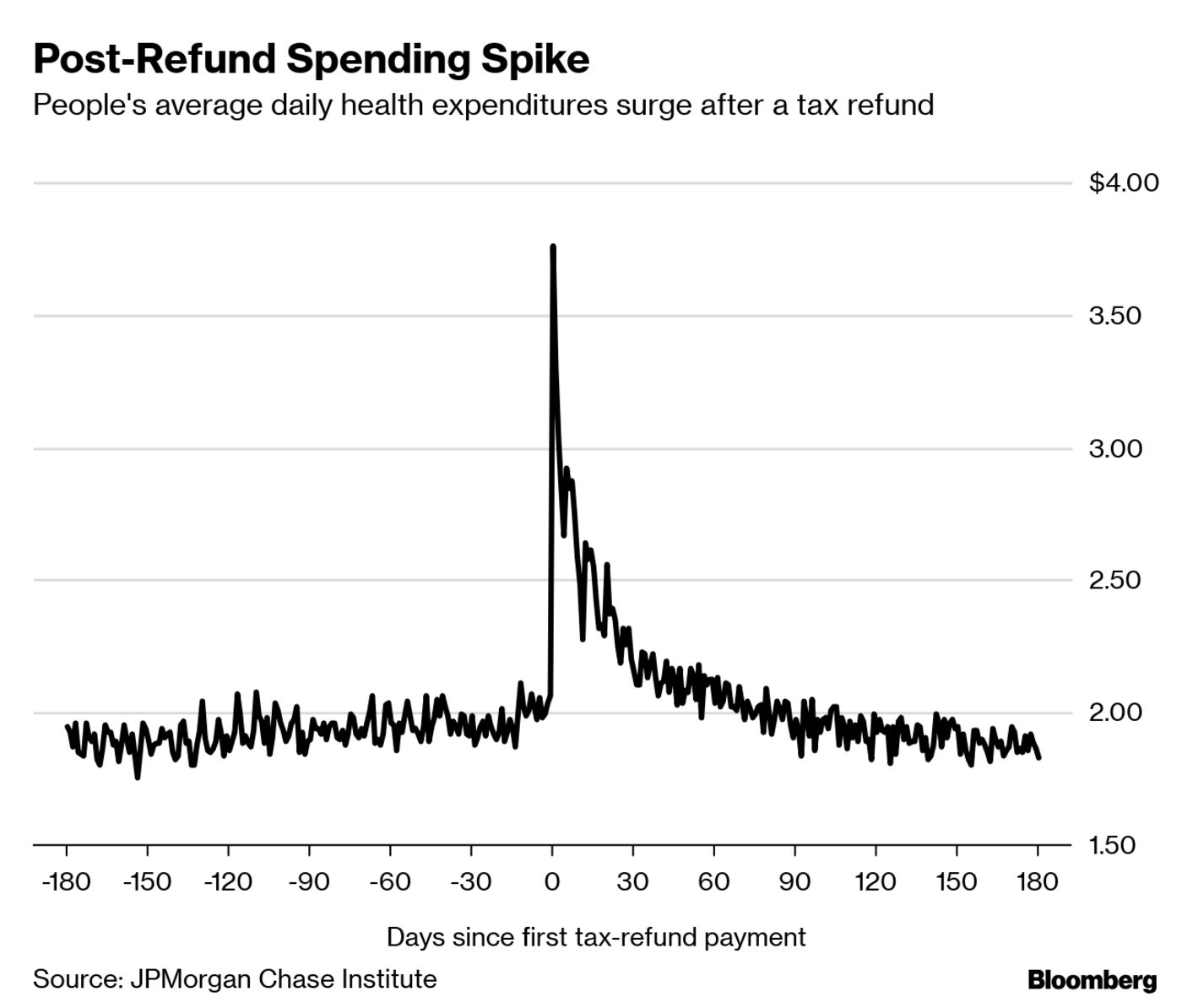
The federal deadline for people to file income taxes is April 15. Out-of-pocket spending on health care jumps about 60 percent in the week after people get their refunds, according to an analysis of account data published last year by the JPMorgan Chase Institute, a research group that draws on the bank’s data. The bulk of that money is spent during face-to-face encounters at clinics, hospitals or other medical providers.
That suggests people aren’t merely using refunds to pay down old debts; they’re waiting until they have cash in hand to get treated.
Post-Refund Spending Spike
“It was surprising, and I’d go so far as to say alarming,” said Fiona Greig, director of consumer research at the JPMorgan Chase Institute. “Those are visits that would have taken place three weeks earlier, had the tax refund arrived three weeks earlier.”
Refunds trigger about a 10 percent increase in the number of people making in-person health-care payments on weekdays, according to the group’s research. Other research from the institute has shown that refunds are also frequently followed by increased cash withdrawals, credit card payments and spending on durable goods.
Tax refunds — the difference between the money withheld from workers’ paychecks and the taxes they actually owe — are the biggest single payment many households receive all year. The average federal refund taxpayers received this spring was $2,873, according to IRS data on filings as of March 29.
More than 1 in 3 working-age Americans skipped a doctors’ visit or medical test, or didn’t fill a prescription, because of the cost last year, according to a recent survey by the Commonwealth Fund, a nonprofit health-research foundation.
Myer, who has insurance, has been forgoing weekly injections for low testosterone, getting them only once a month or less. “That prescription is also just sky-high,” he said, costing about $75 per visit until he reaches his health plan’s deductible.
The medical costs add to a pile of student loans, credit-card debt and payments on his Nissan Rogue. He recently moved back in with his father after he couldn’t afford a rent increase. He also owes money to a psychiatrist who charges a sliding-scale fee. Getting a new prescription for his vision is Myer’s priority, though.

Spring Surge

Dentists and physicians’ offices accounted for the greatest share of in-person health payments that followed tax refunds, the JPMorgan Chase Institute’s report showed. Mark Vitale, a dentist in Edison, New Jersey, said refunds always bring a surge of patients.
“Year after year, what patients will say to me is, ‘Let’s just wait until April 1 or May 1 when I get my tax refund,’” he said. Vitale has practiced for 35 years, and over time, he said, “the dollar has gotten tighter.’’
Three people who booked significant dental procedures like implants or crowns around the beginning of April cited their tax refunds, he said. They’re typically employed, middle-class people. Sometimes they’ve delayed dental work for years.
The research group analyzed data from millions of Chase bank accounts, as well as credit and debit cards, looking for patterns in the movements of money.
The granular picture of how cash flow affects people’s ability to get medical care reveals problems that clinicians, health plans, employers and financial companies ought to grapple with, said Greig.
Doctors need to talk to patients about how to prioritize care if they can’t pay for it. That conversation now happens “in a very incomplete way” with finance staff, rather than clinicians, she said. Employers and health plans should understand that trying to lower spending by pushing more expenses onto households could backfire if they delay care.
“Health problems don’t age well,” Greig said.
https://www.bloomberg.com/news/articles/2019-04-12/what-to-spend-your-tax-refund-on-how-about-the-doctor